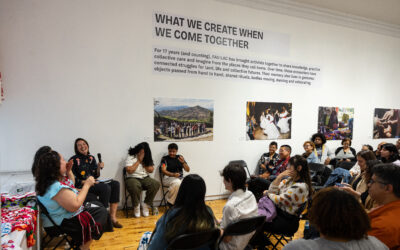
As part of London Climate Action Week 2026—one of the leading global gatherings to advance climate action—FAU LAC brought together funds, partner organizations, and activists. The goal was to introduce those who mobilize resources for climate action to the proposals for climate justice being developed by feminist and social movements in Latin America and the Caribbean.
While authoritarian governments expand extractivism and weaken environmental protections, Latin America and the Caribbean face an increasingly unequal burden from the climate crisis. However, solutions already exist: organized communities, Indigenous peoples, Afro-descendants, and feminist movements across the region have been defending life and territories for generations and building alternatives in the face of these crises.
Creating spaces like this is part of the work that FAU LAC carries out alongside feminist movements in Latin America and the Caribbean. Since 2009, FAU has provided more than 700 grants to support the defense of territories and environmental justice, working alongside communities, organizations, and women defenders who are responding to these crises from within their own territories. Sharing these experiences with those who mobilize resources also helps ensure that funding reaches, in a more direct and sustained manner, those who are already building responses.
That was the starting point for the event “Tending to the roots, seeding the future: feminist climate justice responses to democratic erosion in Latin America and the Caribbean,” which we organized as part of London Climate Action Week 2026.
The event began with a panel featuring Liz McKean, executive director of War on Want; Alex Gordon, policy and development manager at WEDO; Nisha Owen, executive director of Global Greengrants Fund UK; and Joshi Leban, an activist from El Salvador and member of MOMUJEST. The conversation was moderated by Maite Smet, a member of the coordination team for the Protection, Comprehensive Security, and Collective Care area at FAU LAC.
The conversation began by addressing the root causes of these crises. Liz McKean noted that “the violence of extractivism by big corporations, and the violence inflicted on the bodies of women and gender diverse people comes from the same playbook, one that the far-right shares globally.” She also called for recognition that “we have waterways and land because Indigenous communities have been protecting them for centuries at incredible costs,” and invited funders to “rethink what achieving success and building power actually means,” as communities across the region continue redefining power in practice.
If movements are already developing responses, the next question is how to support them in a sustained manner. Alex Gordon (WEDO) addressed this challenge, focusing on the role of philanthropy: “We shouldn’t just support communities when authoritarianism reaches critical levels. We should support them in being able to do their work sustainably before that level of crisis arrives.”
Nisha Owen, Executive Director of Global Greengrants Fund UK, turned her attention to the Caribbean, where civic space continues to shrink while the region receives far too little funding. She also stressed the importance of working together to influence donors and the philanthropic sector. “We cannot fund alone, we need each other to face poly crises. We believe movements will win but they need resources for that,” she said
Drawing on the experience of social movements, Joshi Leban shared the work of MOMUJEST, a feminist organization founded in 2009 in Santo Tomás, El Salvador. There, they stand in solidarity with women and dissidents facing violence, provide legal and psychosocial support, and defend the environment, access to water, and their community’s forest reserves. Her message closed the meeting with an invitation to view hope as a political practice: “We should learn about joy. Something that characterizes popular movements in Latin America and the Caribbean is joy. We have hope. If we didn’t think things were going to change, why would we do what we do? The world is still a hopeful place. It is worth it to fight.”
For FAU LAC, these reflections are part of daily practice. As coordinator Maite Smet noted: “We are all working in a complementary way to support the movements, and we need to continue doing so together. Channeling resources means much more than funding urgent responses: it involves building relationships of trust, strengthening networks, and supporting those who defend life and territories from within their own communities.”
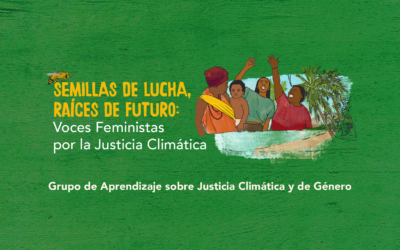
The proposals for climate justice that emerged from this conversation are also featured in “Seeds for transformation, roots for the future: feminist voices for climate justice”, a book that FAU LAC co-authored with 10 organizations from the region. The book brings together eleven stories from women and dissidents defending territories in Latin America and the Caribbean. It shows how climate justice is built every day through care, collective organization, and the defense of life (learn more here).
The meeting reinforced a shared conviction: responses to the climate crisis and the rise of authoritarianism already exist and are being built from the ground up. The challenge is to continue unlocking resources and to ensure that funders, donors, and allied organizations listen to those who are already living through and closely accompanying these experiences, in order to sustainably support the movements that make them possible.